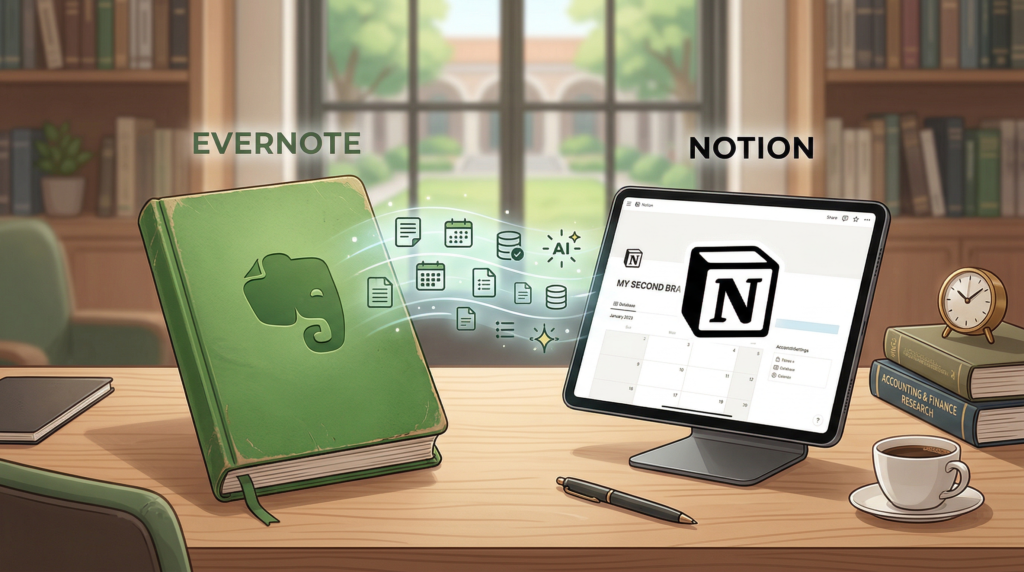
As a junior scholar, my days are often a whirlwind of research, teaching, and administrative duties. Managing these responsibilities requires more than just a calendar; it requires a “Second Brain”—a digital repository where ideas, literature reviews, and project drafts can live and grow. For nearly a decade, that home was Evernote. However, as I navigate the early stages of my academic career, I’ve found that even the most loyal relationships with software must eventually be re-evaluated.
Here is a reflection on my recent transition from Evernote to Notion.
The Golden Era: Evernote as the Academic Standard
I first became a loyal customer of Evernote in 2017. At the time, I was likely much like many of you—looking for a reliable place to store the fragments of my PhD research. In those early days, even the free version of the app felt like an “excellent” and nearly identical version of the premium tool.
There were three specific reasons why Evernote became the backbone of my research work:
- Device Flexibility: Initially, the service could operate on up to three devices. For a researcher balancing a desktop in the office, a smartphone for quick ideas on the go, and a tablet for reading papers, this three-machine constraint was perfectly manageable.
- Capacity for Complexity: The app set a very high bar for the number of notes, notebooks, and tags you could create. This meant I never had to worry about running out of “storage” space for my growing database of accounting and finance literature.
- The Power of Search: Perhaps its greatest strength was—and still is—a search function so powerful that I could easily locate specific notes based on a single query.
It is unsurprising that, in his influential book Building a Second Brain, Tiago Forte recommended Evernote as a premier tool for digital organization (Forte 2022). During its “heydays” in the late 2000s and early 2010s, it truly felt like the industry standard.
The Turning Point: Friction and Financial Shifts
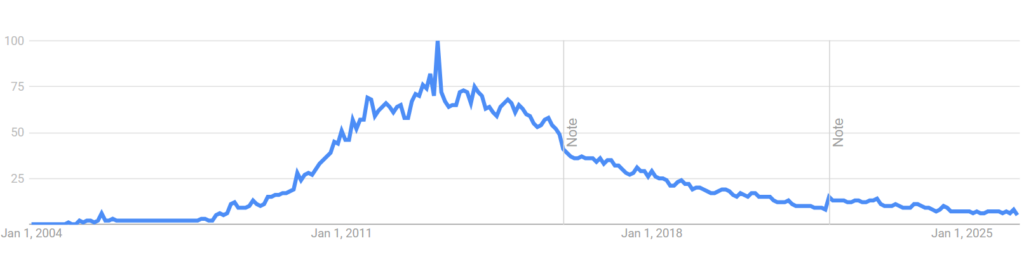
I didn’t realize it then, but the dominance Evernote enjoyed was waning just as I was settling into my subscription (Figure 1). After its initial success, the company faced several operational hurdles, including overexpansion and significant turnover in the management team. Eventually, Evernote was acquired by the Milan-based developer Bending Spoons, marking a major shift in the app’s trajectory (Wiggers 2022).
As an academic, I tend to be sensitive to the “bottom line”—not just in my research, but in my personal productivity budget. Since 2017, the subscription fees for Evernote have ballooned in a way that felt increasingly difficult to justify:
- Device Restrictions: The limit was suddenly reduced from three devices to two. For a scholar who uses a laptop, a tablet, and a smartphone, this created an “intolerable inconvenience” in my daily workflow. In the current free plan, the limit is only one device. This is insane!
- Offline Limitations: Restrictions were imposed on offline usage, disabling functions that I previously relied on when traveling or working in areas with spotty connection.
- The Price Surge: My subscription fee jumped from $25 per year to $50, and eventually to $100 per year. This represents a 400% increase.
While the “switching cost” of moving years of research notes is high, the lack of competitive updates—especially in the burgeoning age of AI—made me feel that the service quality was no longer catching up with the price.
Why I Embraced Notion for My Research Workflow
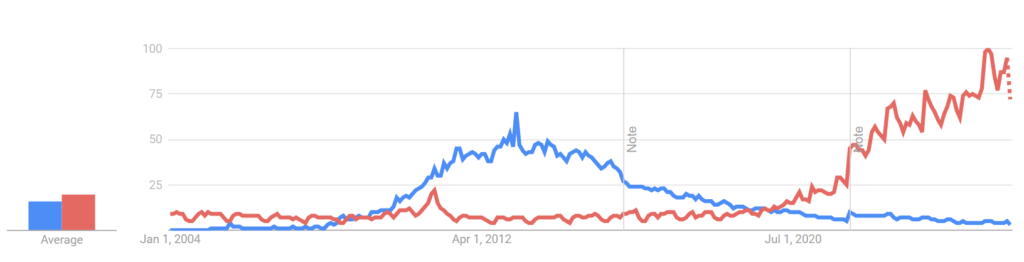
In 2026, a new rival emerged that changed the landscape. Notion has since outperformed Evernote in popularity (Figure 2), and after making the leap, I have found three primary reasons why it suits my current academic life.
1. Integrated Project Management
In my job, I am often juggling multiple research papers with senior colleagues while supervising master’s students. Notion is a superior tool for project management. Specifically, the Notion Calendar integrates my research projects with my Google Calendar, allowing me to track progress and visualize what needs to be done next. This has significantly alleviated the “anxiety” that often accompanies a heavy academic workload, providing much-needed clarity.
2. Freedom of Form
As researchers, our thoughts don’t always fit into a standard “note” format. Notion allows for total freedom in how information is structured. I can drop in data tables, code snippets, or draft outlines without having to perform constant revisions to make the content “suitable” for the app.
3. AI-Driven Insights
In this age of AI, the ability to synthesize information is paramount. I can now utilize various AI tools to explore all the pages in my workspace. This allows me to distill insights and find links between disparate notes that I might have otherwise overlooked. For a researcher in finance and accounting, seeing these connections can lead to better-structured projects and more innovative research ideas.
Final Thoughts: Moving Forward
Saying goodbye to Evernote was not easy; it was the tool that powered my “Second Brain” through the most formative years of my training. However, as a junior scholar looking toward the future, I believe it is important to choose tools that grow with us.
If you are currently feeling the friction of rising costs or limited functionality in your current setup, I encourage you to look at your workflow not as a static habit, but as an evolving system. For me, moving to Notion wasn’t just about saving on a subscription; it was about finding a space that truly understands the multifaceted nature of academic work.
References
- Forte, Tiago. 2022. Building a Second Brain: A Proven Method to Organize Your Digital Life and Unlock Your Creative Potential. Simon and Schuster.
- Wiggers, Kyle. 2022. “Bending Spoons Acquires Evernote, Marking the End of an Era.” TechCrunch, November 16. https://techcrunch.com/2022/11/16/bending-spoons-acquires-evernote-marking-the-end-of-an-era/.