Have you ever been told by a supervisor or a peer reviewer that your paper needs to “tell a better story”?
When I was in my PhD program, I heard this constantly. To be honest, it baffled me. I’m writing a rigorous academic paper, not a novel—so where does the “story” fit in? It wasn’t until I read “Storytelling with Data” by Cole Nussbaumer Knaflic that the lightbulb finally went off.
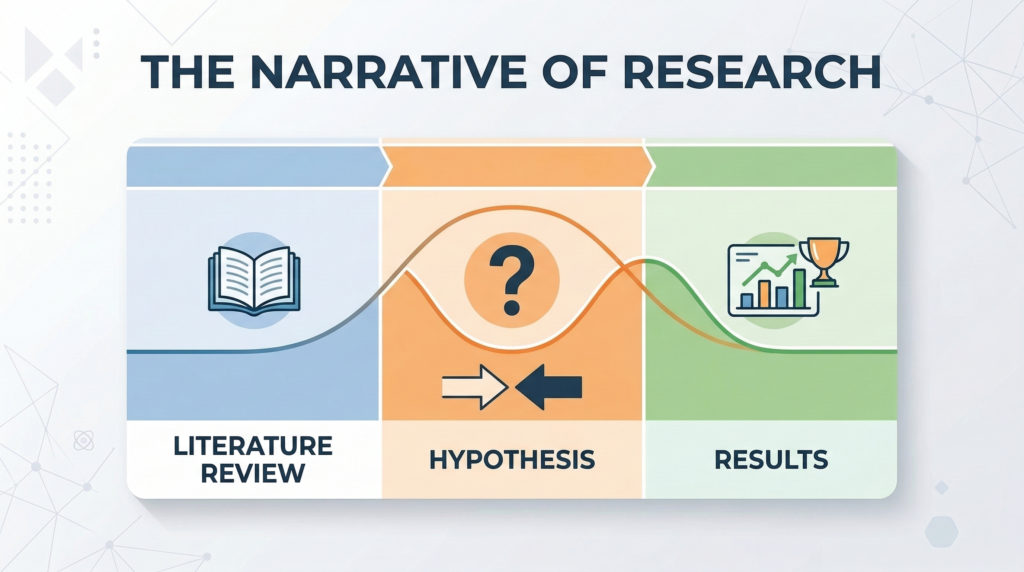
The book outlines a classic three-act storytelling formula applicable in data visualization: The Beginning, The Middle, and The End. Surprisingly, this is the exact blueprint for a successful literature review and hypothesis development.
If you want to transform your dry manuscript into a compelling narrative, here is how you can map the storytelling formula onto your academic writing.
Act I: The Beginning (Setting the Scene)
In a story, the beginning establishes the context. It introduces the characters and the world they live in so the audience understands the stakes.
In an academic paper, this is your Institutional Background and Literature Review. Some researchers—including me—may make the mistake of simply listing previous studies like a grocery list. Instead, think of this section as context-building. You are providing the reader with the essential “need-to-know” information. By the time the reader finishes your literature review, they should have a clear mental map of the current landscape, making them perfectly prepared for your specific research question.
Act II: The Middle (The Tension and Conflict)
Every great story needs a “hook”—a conflict that the protagonist must resolve. Without tension, the story is boring.
In your paper, this is your Hypothesis Development. This is where most writers may lose their audience. To make your hypothesis interesting, you need to introduce intellectual tension. Don’t just present arguments that support your hypothesis. Introduce the “conflict” by discussing:
- Competing theories.
- Arguments that might weaken your hypothesis.
- Gaps in current understanding.
By doing this, you prove that your research question isn’t a “so-what” or an obvious conclusion. You are showing that there is a genuine empirical conflict worth investigating. You’ve created a “mystery” that only your data can solve.
Act III: The End (The Resolution)
The end of a story provides the payoff. The protagonist faces the conflict and finds a solution.
In academic terms, this is your Research Design and Empirical Results. This is where you bring out the “heavy machinery”—rigorous econometric methods and causal inference.
Your goal here is to resolve the tension you created in Act II. By using robust data and precise methodology, you dissolve the reader’s doubts. You aren’t just showing numbers; you are providing the resolution to the intellectual problem you posed earlier.
Why This Matters for Publication
Academic writing is about more than just transmitting information; it’s about persuasion. When you frame your paper as a story, you lead the reviewer by the hand. You take them from “Here is the world” (Background), to “Here is the problem” (Hypothesis), to “Here is the answer” (Results).
I finally understand what my professors meant all those years ago. A paper isn’t just a report of what you did; it’s a narrative of discovery. Next time you sit down to write, ask yourself: What is the conflict in my story, and how does my data resolve it?