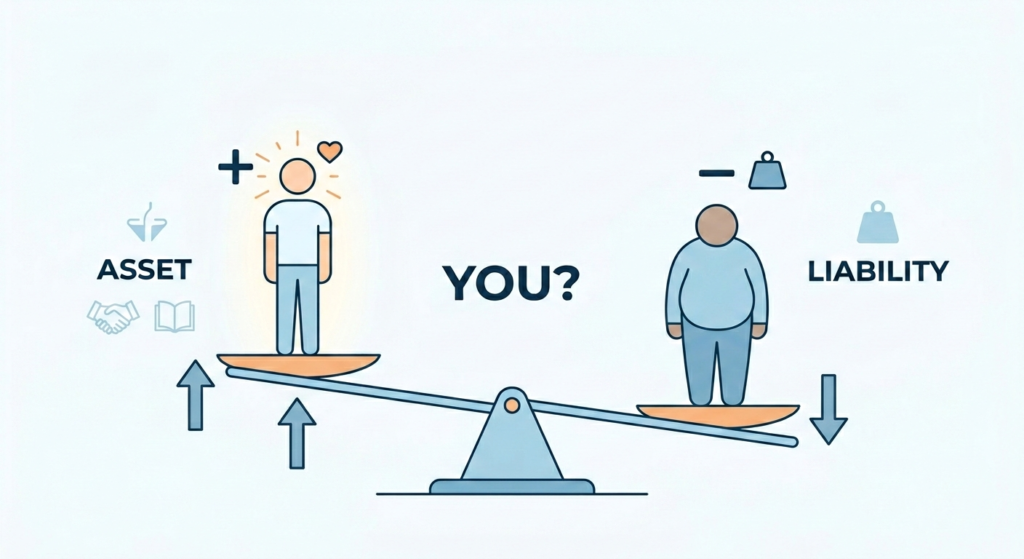
A Lesson in Relationships from the World of Accounting
In the field of accounting, we are taught a fundamental distinction that governs the financial health of any entity: Assets are resources controlled by an individual or organization that are expected to provide future economic benefits. In contrast, Liabilities are present obligations that require a future sacrifice of resources, such as cash, goods, or services.
As a professor in this field, I have realized that this principle is not confined to ledgers and balance sheets. It applies with remarkable precision to the dynamics of human connection. Every interaction we have contributes to a “Relationship Balance Sheet” in the minds of others.
The Nature of Personal Assets
When we are viewed as an asset in someone’s life, it signifies that our presence creates value. In a relational context, “economic benefit” is translated into emotional capital. This doesn’t mean the relationship is transactional; rather, it means that by being ourselves, we offer practical support, intellectual inspiration, or a sense of peace.
An asset enriches the other person’s future. Whether it’s through a listening ear during a crisis or shared joy during a celebration, being an asset means you are an investment that pays dividends of happiness and stability over time.
The Hidden Cost of Liabilities
On the other hand, we become a liability when our presence consistently demands more than it gives. This occurs when we become a primary source of emotional drain, constant negativity, or recurring stress.
In accounting, a heavy debt burden can lead to insolvency. Similarly, in life, if we become a person who requires a “future sacrifice of resources”—be it the other person’s time, mental energy, or well-being—without ever replenishing them, a deficit begins to grow. Human nature is inherently rational and self-protective. No one can carry a heavy, non-performing liability indefinitely without eventually facing emotional bankruptcy. When the cost of maintaining a relationship exceeds the value it brings, distance is the natural, albeit painful, protective measure.
Avoiding “Emotional Leverage”
A common mistake is using “friendship” or “family ties” as a form of emotional leverage. We often expect unconditional tolerance because of a title—”But I’m your best friend” or “We are family.” In accounting terms, this is like trying to force a bad investment based on past brand loyalty.
However, even the most established “equity” can be depleted. We cannot “blackmail” our way into someone’s heart using past history if our current presence is a heavy burden. When the weight becomes too much, even the deepest bonds will eventually erode under the pressure of constant sacrifice.
The Ultimate Goal: A Positive ROA
Therefore, it is worth pausing regularly to audit our own behavior. We should ask ourselves:
“Am I showing up as an asset to those I love, or am I slowly becoming a liability they feel obligated to carry?”
True maturity in any relationship is found when both parties aim for a positive “Return on Assets” (ROA). A healthy relationship isn’t just about avoiding debt; it’s about ensuring that the collective value created together is far greater than the sum of its parts. By striving to be an asset, we ensure that our relationships remain not just sustainable, but flourishing and full of life.